
Fragile Threads: Investigating Humanity’s Web of Treaties
Introduction: A Treaty Hidden in Plain Sight
When listeners tuned into a BBC broadcast in September 2025, they may have been startled by a seemingly mundane revelation: Mexico and the United States are bound by a treaty about water sharing. For many, this was the first encounter with the 1944 Treaty Relating to the Utilization of Waters of the Colorado and Tijuana Rivers and of the Rio Grande. The idea that a river could be regulated by treaty, with water “debts” tallied between nations, underscores an often invisible truth: the international system rests on tens of thousands of treaties that quietly stabilise the everyday flow of goods, people, and resources (International Boundary and Water Commission [IBWC], 2023).
Yet this very discovery raises another silence: where are the treaties signed between settler states and Indigenous peoples? The official maps of global treaties exclude them, despite their foundational importance. This oversight is not only technical but symbolic, echoing the fragility of Indigenous rights in today’s politics — and raising a mirror to the fragility of international treaties themselves.
What Is a Treaty?
Under the Vienna Convention on the Law of Treaties (1969), a treaty is “an international agreement concluded between States in written form and governed by international law” (United Nations, 1969, Art. 2). This definition locks Indigenous treaties outside the frame: agreements between sovereign nations like the Māori rangatira and the British Crown in 1840, or First Nations and Canada in the late 19th century, are not counted as “treaties” in international law.
The consequence? The scaffolding of sovereignty that Indigenous peoples negotiated is sidelined as “domestic law.” Meanwhile, inter-state treaties are lionised as the basis of civilisation. This is not just a scholarly distinction — it mirrors colonial hierarchies of power that persist to this day.
Mapping the Categories of Treaties
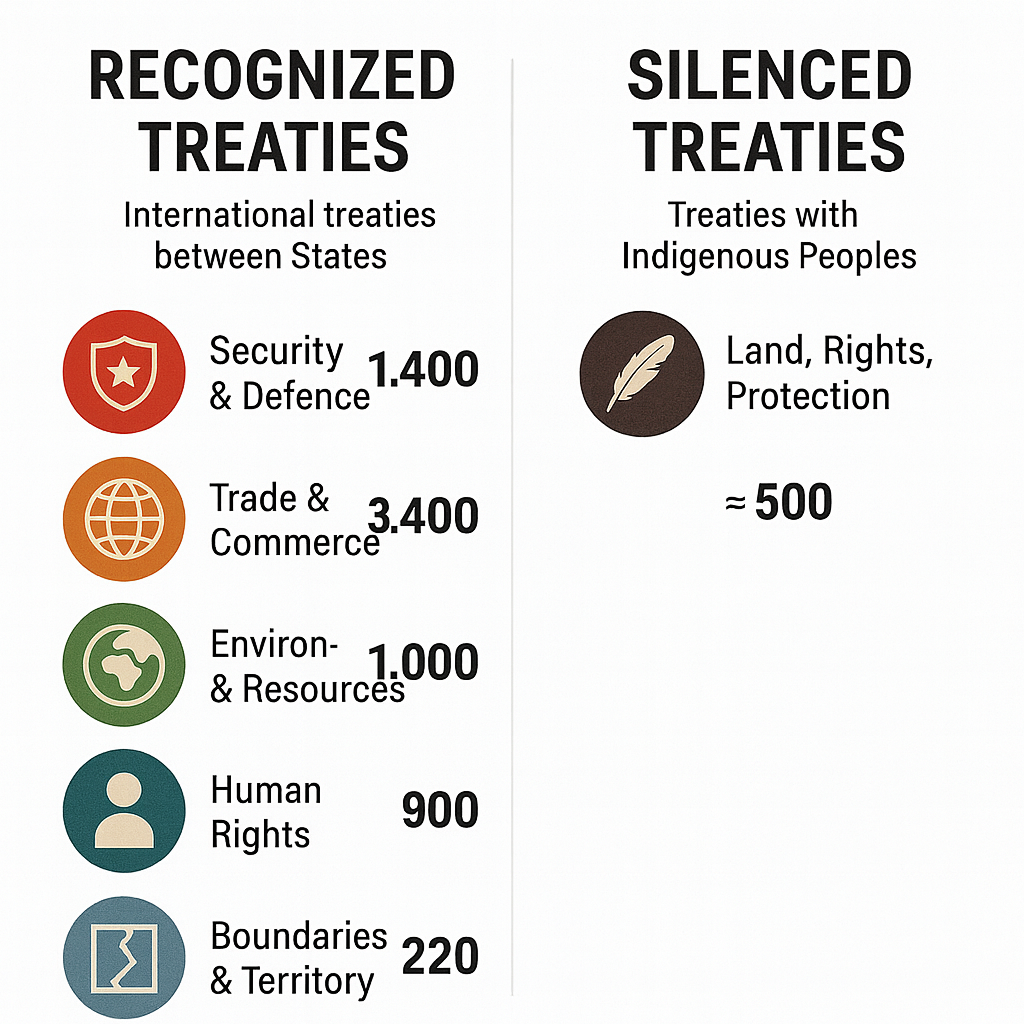
To grasp the global web of agreements, we must categorise them. The principal domains of treaty-making reflect humanity’s persistent anxieties: security, trade, resources, human rights, territory, transport, science — and, if we are honest, Indigenous sovereignty.
1. Security and Defence
Security treaties remain central. The North Atlantic Treaty (1949) established NATO, still the bedrock of Western defence (NATO, 2024). Arms control agreements like the Nuclear Non-Proliferation Treaty (1968) attempted to slow nuclear spread (International Atomic Energy Agency [IAEA], 2023). Yet contrast this with Indigenous treaties: the Crow Nation’s treaties with the U.S. in the 19th century promised security and protection in exchange for land. Those promises, like so many, were broken (Wilkins & Lomawaima, 2001).
2. Trade and Commerce
Trade treaties are numerically dominant: WTO agreements (1995), regional blocs like CPTPP (WTO, 2025), and more than 2,500 bilateral investment treaties (UNCTAD, 2024). But Indigenous treaties also contained economic clauses: the Numbered Treaties in Canada promised annuities, farming tools, and hunting rights in exchange for land cessions (Miller, 2009). Today, those provisions remain disputed, demonstrating that Indigenous treaties, like trade treaties, govern flows of goods and rights — only less visibly.
3. Environment and Resources
The Paris Climate Agreement (2015) binds states to emission pledges (UNFCCC, 2015). The Indus Waters Treaty (1960) divides rivers between India and Pakistan (World Bank, 2020). Yet Indigenous treaties were often, in essence, environmental compacts: guaranteeing rights to fish, hunt, and gather across traditional lands. In New Zealand, the Treaty of Waitangi (1840) promised Māori tino rangatiratanga (authority) over taonga, including natural resources (Orange, 2015). The marginalisation of these compacts in official records symbolises the continued dispossession of Indigenous peoples.
4. Human Rights and Humanitarian Law
The Geneva Conventions (1949) codified rules of war (ICRC, 2020). The International Covenant on Civil and Political Rights (1966) created human rights norms (OHCHR, 2023). Indigenous treaties similarly promised rights — cultural, religious, and political autonomy — but these are seldom honoured. Their absence from human rights tallies highlights the paradox: the world recognises universal human rights globally but overlooks historical treaty rights domestically.
5. Boundaries and Territory
Every inter-state border rests on treaties: Africa’s colonial boundaries, Asia’s demarcations, the U.S.–Soviet maritime boundary (1972). But Indigenous treaties are boundary treaties too: they fixed the terms under which settlers could enter and occupy Indigenous land. The Waitangi Tribunal in New Zealand and Truth and Reconciliation processes in Canada are modern reminders that these “internal” boundaries are contested to this day.
6. Transportation and Communications
The Chicago Convention (1944) lets planes cross borders; the Outer Space Treaty (1967) forbids sovereignty in orbit (ICAO, 2022; UNOOSA, 2024). Indigenous treaties also dealt with mobility: agreements often guaranteed freedom of movement across ceded territories for hunting and trade. These provisions are largely invisible in the global “transport treaties” narrative.
7. Health and Science
The International Health Regulations (2005) mandate outbreak reporting (WHO, 2023). TRIPS harmonises intellectual property. Yet Indigenous treaties, too, spoke to wellbeing: commitments to provide medicine, famine relief, and education. Like global health treaties, these were about survival. Their neglect underscores how settler societies redefined such obligations as charity rather than binding law.
Counting the Web of Treaties — and the Silences
The UN Treaty Series registers over 560,000 treaty actions since 1946 (United Nations, 2024). Scholars estimate 40,000–50,000 distinct treaties in force (Aust, 2013). But these counts exclude Indigenous treaties entirely.
This is not just archival oversight. It is symbolic coincidence: the very treaties Indigenous peoples struggle to have respected are erased from the “global” story. Their invisibility distracts from the fact that modern states exist because those treaties were signed. If these foundational compacts can be ignored, what confidence can we have that today’s climate or trade treaties will not meet the same fate?
Fragility and Conflict
The war in Ukraine, the water tensions between the U.S. and Mexico, and the collapse of arms treaties all highlight fragility. But so too do disputes over Treaty of Waitangi settlements or Canada’s unfulfilled Numbered Treaties. The neglect of Indigenous treaties foreshadows a broader risk: that all treaties, however solemn, can become optional under political pressure.
Why Treaties Exist: Snapshots from All Layers
- North America (Security): NATO still deters aggression, but U.S.–Native treaties show how protection promises can be broken.
- Asia (Trade): CPTPP reflects adaptation, while Indigenous compacts remind us that trade obligations can be hollowed out.
- South Asia (Environment): Indus Waters Treaty remains stable, while Indigenous fishing rights (e.g., U.S. Pacific Northwest tribes) remain under litigation.
- Europe (Human Rights): The European Convention on Human Rights empowers individuals, yet Indigenous treaty rights show how individual rights often eclipse collective rights.
- Africa (Boundaries): Colonial borders were frozen to prevent chaos, but Indigenous land rights are still undermined by state-centric boundaries.
- Global (Transport/Communication): Air travel relies on treaties; Indigenous peoples once relied on treaties for free passage across ancestral lands.
- Polar/Scientific (Health & Science): Antarctic cooperation endures; Indigenous peoples still wait for healthcare promises in their treaties to be honoured.
Conclusion: The Fragile Web — Seen and Unseen
The discovery that Mexico “owes” water to the U.S. under a treaty is not an anomaly. It is emblematic of how deeply our world depends on fragile contracts. Yet the absence of Indigenous treaties in global counts reveals a dangerous distraction: the fragility of Indigenous compacts mirrors the fragility of international ones. Both are vulnerable to neglect, reinterpretation, or abandonment.
The oversight is symbolic and cautionary. If the oldest treaties — those with Indigenous peoples — can be sidelined, then the “global web” of treaties we trust today may one day be ignored too.
What if the fragility we see in Indigenous treaties is a warning sign — that the scaffolding of global stability itself could unravel, leaving us to rediscover why these agreements were forged in the first place?
References
Aust, A. (2013). Modern treaty law and practice (3rd ed.). Cambridge University Press.
Council of Europe. (2023). European Convention on Human Rights. Retrieved from https://www.coe.int/en/web/echr
International Atomic Energy Agency. (2023). Treaty on the Non-Proliferation of Nuclear Weapons (NPT). Retrieved from https://www.iaea.org
International Boundary and Water Commission. (2023). 1944 Water Treaty. Retrieved from https://ibwc.gov
International Civil Aviation Organization. (2022). Chicago Convention. Retrieved from https://www.icao.int
International Committee of the Red Cross. (2020). The Geneva Conventions of 1949 and their Additional Protocols. Retrieved from https://www.icrc.org
North Atlantic Treaty Organization. (2024). The North Atlantic Treaty, 1949. Retrieved from https://www.nato.int
Office of the High Commissioner for Human Rights. (2023). International Covenant on Civil and Political Rights. Retrieved from https://www.ohchr.org
Orange, C. (2015). The Treaty of Waitangi. Bridget Williams Books.
Organization of African Unity. (1964). Cairo Declaration on Border Disputes. Retrieved from https://au.int
Secretariat of the Antarctic Treaty. (2024). Antarctic Treaty System. Retrieved from https://www.ats.aq
United Nations. (1969). Vienna Convention on the Law of Treaties. Treaty Series, 1155 U.N.T.S. 331.
United Nations. (1982). United Nations Convention on the Law of the Sea. Retrieved from https://www.un.org/depts/los
United Nations. (2024). United Nations Treaty Collection. Retrieved from https://treaties.un.org
United Nations Conference on Trade and Development. (2024). International Investment Agreements Navigator. Retrieved from https://investmentpolicy.unctad.org
United Nations Framework Convention on Climate Change. (2015). Paris Agreement. Retrieved from https://unfccc.int
United Nations Office for Outer Space Affairs. (2024). Outer Space Treaty. Retrieved from https://www.unoosa.org
Universal Postal Union. (2023). History of the UPU. Retrieved from https://www.upu.int
U.S. Arms Control Association. (2021). U.S. withdrawal from arms treaties. Retrieved from https://www.armscontrol.org
U.S. Department of State. (1972). Agreement on the maritime boundary in the Bering Sea. Washington, DC: U.S. Government.
Wilkins, D. E., & Lomawaima, K. T. (2001). Uneven ground: American Indian sovereignty and federal law. University of Oklahoma Press.
World Bank. (2020). Indus Waters Treaty: A history and its relevance. Retrieved from https://www.worldbank.org
World Health Organization. (2023). International Health Regulations (2005). Retrieved from https://www.who.int
World Trade Organization. (2025). Regional trade agreements database. Retrieved from https://www.wto.org
Miller, J. R. (2009). Compact, contract, covenant: Aboriginal wordptreaty-making in Canada. University of Toronto Press.